


Keywords
Abstract
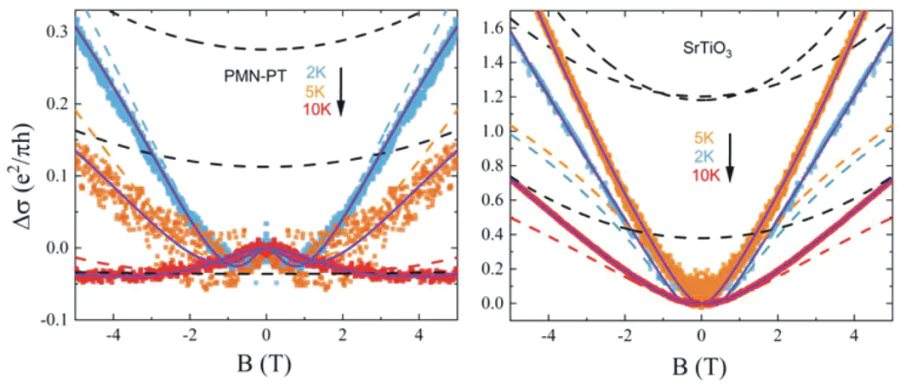
We study the low-temperature quantum conductance corrections in epitaxial SrIrO3 thin films grown on substrates that impose biaxial strain of different sign and magnitude. The most instructive pair are the films on Pb(Mg1/3Nb2/3)O3–PbTiO3 (PMN-PT) and SrTiO3, which carry strain of opposite sign and nearly equal magnitude — tensile ε = +1.5% and compressive ε = −1.4% — while NdGaO3 and (LaAlO3)0.3(Sr2TaAlO6)0.7 (LSAT) provide progressively stronger compression. In all films the resistivity rises logarithmically on cooling, the signature of two-dimensional quantum corrections, and the magnetoconductance is well described by the two-dimensional Maekawa–Fukuyama model with a classical quadratic orbital background. The sign of the strain governs the character of the corrections: the tensile PMN-PT film sustains weak antilocalization, seen as a zero-field conductance peak, whereas the compressive films cross over to weak localization, where the magnetoconductance is parabolic and shows no peak — the Maekawa–Fukuyama model describes both regimes equally well. The extracted phase-coherence length follows the temperature dependence expected for two-dimensional electron–electron (Coulomb) scattering, confirming the two-dimensional nature of the corrections despite the finite film thickness. The tensile and weakly compressed films display an intrinsic, hysteresis-free anomalous Hall effect of Berry-curvature origin, which is suppressed under the strongest compression. The sign and magnitude of the substrate-imposed strain thus govern the quantum conductance corrections in SrIrO3 thin films.